Arrey, New Mexico — a theodolite track by a Skyhook balloon crew
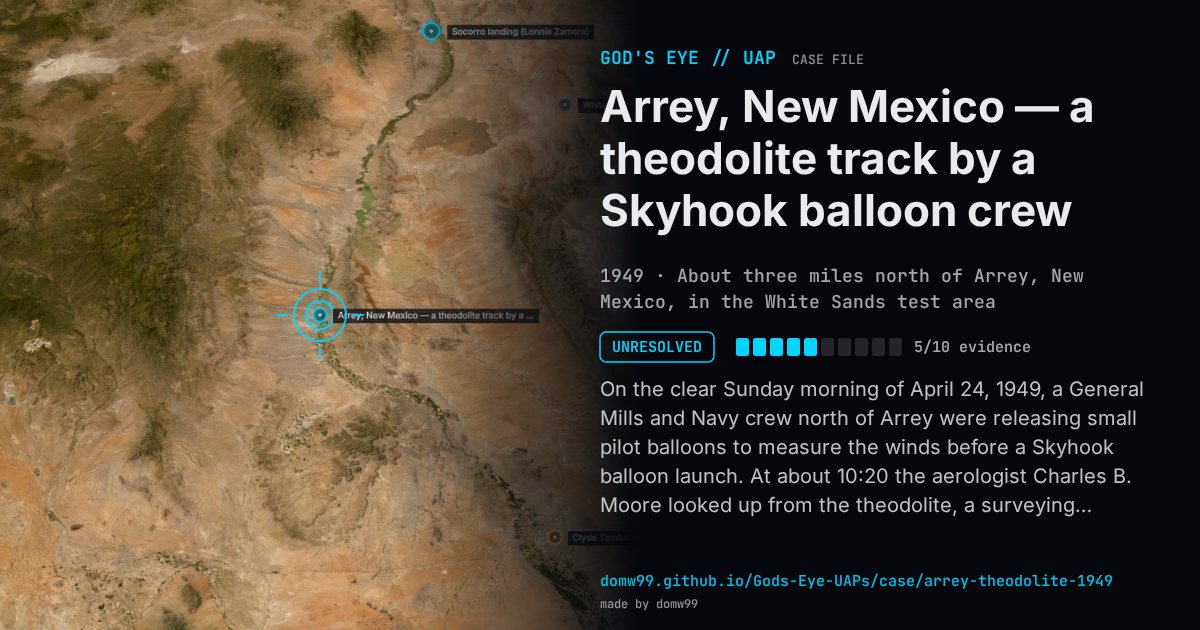
On the clear Sunday morning of April 24, 1949, a General Mills and Navy crew north of Arrey were releasing small pilot balloons to measure the winds before a Skyhook balloon launch. At about 10:20 the aerologist Charles B. Moore looked up from the theodolite, a surveying telescope on a graduated mount, and saw a small white ellipsoid moving fast across the sky. He swung the instrument onto it and, with a stopwatch, the crew followed it for about a minute: it was first at about 45° elevation, moved at roughly five degrees a second, dropped towards 25°, then climbed steeply and was gone. There was no sound, trail or exhaust. The Navy’s Special Devices Center sent Moore’s written report to the Chief of Naval Operations with a letter noting that the readings might indicate controlled flight; Project Grudge and later Blue Book carried the case as unidentified. Ruppelt counted it among the best sightings made at White Sands, and Moore, who later became a respected atmospheric physicist, never accepted the mirage explanation offered for it.
Explanation
Blue Book’s record card says “Unidentified”. A pilot balloon released about fifteen minutes later was tracked to show the object could not have been a free balloon at that angular speed. Donald Menzel later proposed a mirage of the crew’s own balloon; Moore rejected it, and the theodolite readings do not fit it well. A meteor does not fit the minute-long track without a trail.
What was seen
Shape: A white ellipsoid, about 2.5 times as long as it was wide, light yellow on one side
Witnesses: Charles B. Moore, a General Mills aerologist, and four Navy enlisted men from White Sands
Duration: About 60 seconds
Sources
- Edward Ruppelt, The Report on Unidentified Flying Objects (1956), Chapter 5 (Project Gutenberg)
- The Arrey case: Moore’s report, the record card and the debate (transcribed)
Browse
- United States
- 1940s
- Unresolved
- Radar-visual cases
- Official government documents
- Military witnesses
- Infrared or other sensor data
- Lights and fireballs