Great Meteor Procession
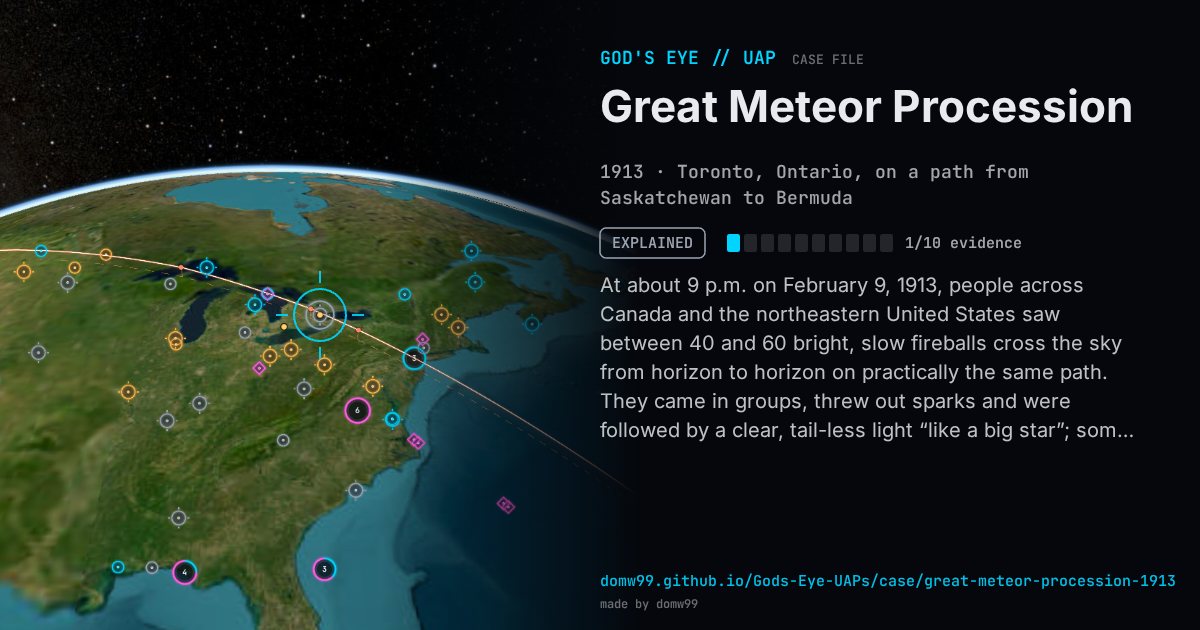
At about 9 p.m. on February 9, 1913, people across Canada and the northeastern United States saw between 40 and 60 bright, slow fireballs cross the sky from horizon to horizon on practically the same path. They came in groups, threw out sparks and were followed by a clear, tail-less light “like a big star”; some witnesses heard rumbling. The same procession was reported from Bermuda and from ships as far south as Brazil, a ground track of more than 11,000 km. Much of the populous Northeast was under cloud, so most of the reports came from rural Canada. From the sound reports William Pickering put the meteors at about 56 km up. O’Keefe later named them the Cyrillids, after the feast day of St. Cyril of Alexandria, February 9.
Explanation
The astronomer Clarence Chant collected more than a hundred reports and found they all lay along one great-circle arc, with no radiant. He concluded the fireballs were the pieces of a small, short-lived natural satellite of the Earth, breaking up as it grazed the atmosphere. Later studies by John O’Keefe and others agreed.
What was seen
Shape: A procession of 40 to 60 slow fireballs in groups, with a bright tail-less body at the rear
Witnesses: More than a hundred reports from Canada, the northeastern United States, Bermuda and ships at sea
Duration: Each fireball 30–40 seconds; the whole procession about five minutes