Fátima — the “miracle of the sun”
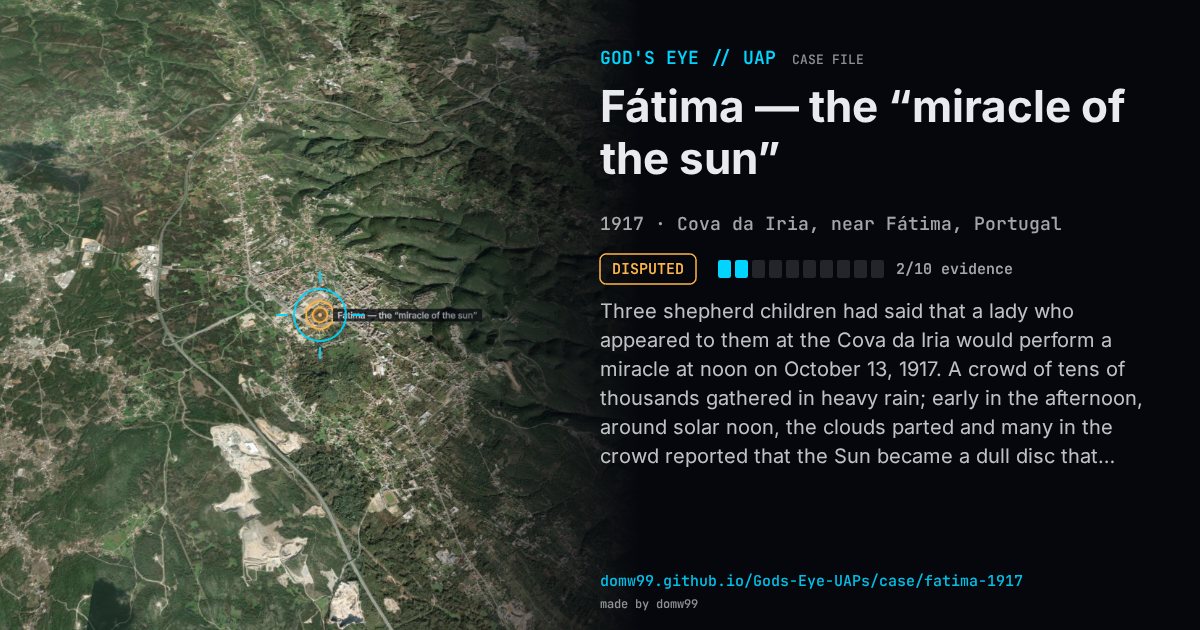
Three shepherd children had said that a lady who appeared to them at the Cova da Iria would perform a miracle at noon on October 13, 1917. A crowd of tens of thousands gathered in heavy rain; early in the afternoon, around solar noon, the clouds parted and many in the crowd reported that the Sun became a dull disc that could be looked at, spun, threw off coloured light, zig-zagged and seemed to fall towards them before returning to its place, and that their soaked clothes dried at once. Newspaper accounts, including the anticlerical O Século, described the crowd’s reaction; not everyone present saw the Sun move, and no astronomical observatory recorded anything unusual. The Church recognised the apparitions in 1930. Physicists and sceptics explain the sight as what the eye does when it stares at the Sun, with suggestion doing the rest.
Explanation
The Catholic Church declared the apparitions “worthy of belief” in 1930. Scientists point to the effects of staring at the Sun through thinning cloud (after-images, bleached photoreceptors and the illusion of movement), perhaps helped by high dust or a sundog, and to a crowd that had been told to expect a sign. Some ufologists have reinterpreted it as a UFO event; nothing was seen in the sky by observatories, or by people away from the crowd.
What was seen
Shape: The Sun as a dull, spinning silver disc, casting coloured light and seeming to plunge towards the earth
Witnesses: A crowd usually estimated at 50,000 to 70,000, including journalists such as Avelino de Almeida of O Século
Duration: About ten minutes
Sources
Browse
- Portugal
- 1910s
- Disputed
- Mass sightings
- Many independent witnesses
- Photographs
- Lights and fireballs
- Discs and saucers